
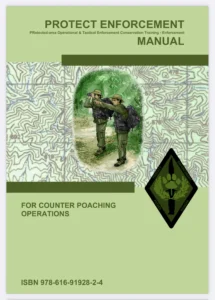
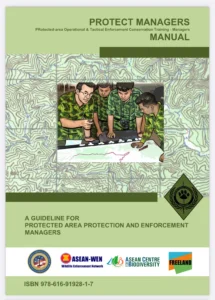
PROTECT is a comprehensive training package for defenders of protected areas which can be tailored to the specific needs of rangers, parks and protected areas, and governments.
PROTECT encompasses 7 levels of training courses, each aimed at a specific role within the habitat protection system, and can be tailored to meet the needs of protected-area staff of all levels, from frontline staff to park managers.
The manuals are based on the ASEAN Center for Biodiversity’s competency standards. Both enforcement and manager manual available in English, Hindi, French, Bahasa Indonesia, Chinese, Khmer, Lao, Vietnamese and Thai language.
For more information send queries to info@freeland.org
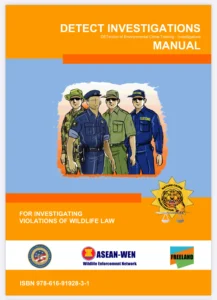
DETECT is a comprehensive capacity building program for wildlife crime investigators.
DETECT encompasses 6 layers of training modules from frontline investigators to investigation managers. DETECT trainees may also receive on-the-job training and attend regional / national Counter Transnational Organized Crime (CTOC) trainings, which include a module on Open Source Intelligence (OSINT). Available in English, Hindi, French, Bahasa Indonesia, Chinese, Khmer, Lao, Vietnamese and Thai language.
PROTECT manuals are available for download. Due to the confidential nature of the law enforcement subject matter, please click here to request access to the manuals.
For more information send queries to info@freeland.org
The COUNTER TRANSNATIONAL ORGANIZED CRIME (CTOC) program was designed for law enforcement agencies across the globe to improve cross-agency and cross-border collaboration to combat transnational organized crime.
Special CTOC sub-programs have been developed for countering wildlife trafficking and human trafficking. CTOC manuals are a core reference for law enforcement training instructors using the CTOC program. Course materials were designed as an integrated package whereby each component builds upon the other. It is recommended to apply the manual in its entirety wherever feasible. However, each CTOC course can be tailored to each target audience, emphasizing modules that are most valuable to that audience. Available in English, Thai, Khmer, Vietnamese and Lao language.
CTOC manuals are available for download. Due to the confidential nature of the law enforcement subject matter, please click here to request access to the manuals.
For more information send queries to info@freeland.org
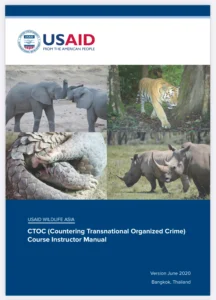
The CTOC program was designed by Freeland for law enforcement agencies across the globe to improve cross-agency and cross-border collaboration to combat transnational organized crime.
Special CTOC sub-programs have been developed for countering wildlife trafficking and human trafficking. CTOC manuals are a core reference for law enforcement training instructors using the CTOC program. Course materials were designed as an integrated package whereby each component builds upon the other. It is recommended to apply the manual in its entirety wherever feasible. However, each CTOC course can be tailored to each target audience, emphasizing modules that are most valuable to that audience.
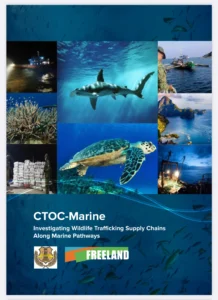
The CTOC-Marine (CTOC-M) training program was designed to help enforcers analyze, investigate and dismantle trafficking syndicates using marine pathways. CTOC-M is an adaption of CTOC, which was born from the realization that no one agency or country can address the problem of counter transnational crime alone.
CTOC Marine Manual is available in Bahasa Indonesia, Bahasa Malaysia and English.
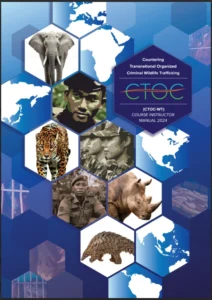
The CTOC-Wildlife Trafficking (CTOC-WT) training program was designed to help enforcers analyze, investigate and dismantle trafficking syndicates using wildlife trafficking pathways. CTOC-WT is an adaption of CTOC, which was born from the realization that no one agency or country can address the problem of counter transnational crime alone.
CTOC- WT Manual is available in Thai, Vietnamese, Laos, and English.
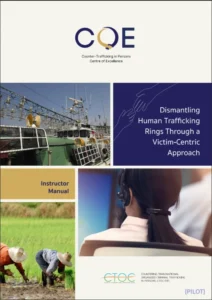
The CTOC- Trafficking in Persons (CTOC-TIP) training program was designed to help enforcers analyze, investigate and dismantle human trafficking rings and syndicates through a victim-centric approach. CTOC-TIP is an adaption of CTOC, which was born from the realization that no one agency or country can address the problem of counter transnational crime alone.
CTOC-CTIP Manual is available in Thai and English.
CTOC manuals are available for download. Due to the confidential nature of the law enforcement subject matter, please click here to request access to the manuals.
For more information send queries to info@freeland.org
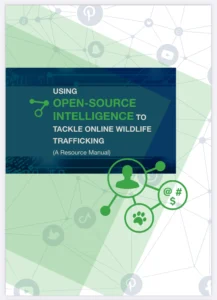
Open-Source Intelligence (OSINT) is data collected from publicly available sources to provide the intelligence needed on a given operation. OSINT is also the process of collecting and analyzing of said data to produce a comprehensive understanding of an individual, collective, place, or thing.
According to the US Intelligence Community, “OSINT is primarily used in national security, law enforcement and business intelligence functions. It is of value to analysts who use non- sensitive information in answering classified, unclassified, or proprietary intelligence requirements across all intelligence disciplines.” In the context of this manual, open-source refers to information that can be collected from the Internet, is within the public domain, and is available to be used in building an online investigation of a target entity, which may be a person, group of people or a company. OSINT is made up of, and built on many pieces of information, known as breadcrumbs.
Available in English and Bahasa Indonesia.
Due to the confidential nature of the law enforcement subject matter, please click here to request access to the manuals.
Send queries to info@freeland.org
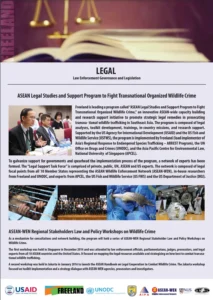
ASEAN law enforcement handbook provides criminal justice and law enforcement officials from the ASEAN region with a strategic approach to deploying an arsenal of hard and soft laws and other associated tools for the prosecution of wildlife crimes. These include international cooperation, mutual legal assistance, anti-money laundering statutes, and extradition.
The handbook provides guidance on how these national and regional tools might be relevant to the investigation and prosecution of wildlife crime cases, and in processing or considering requests for assistance across ASEAN borders.
A first of its kind for wildlife trafficking enforcement, the handbook complements existing ASEAN/ UN tools on combating transnational organized crimes, in particular the ASEAN Handbook on International Legal Cooperation in Trafficking in Persons Cases, and the Wildlife and Forest Crime Analytic Toolkit, both published by UNODC.
The ASEAN Handbook on Legal Cooperation to Combat Wildlife Crime was launched in January 2016 at the Jakarta workshop.
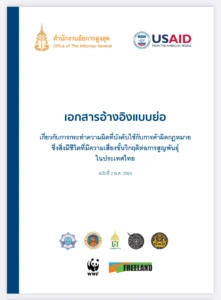
The RAPID REFERENCE GUIDE (RRG) contains brief descriptions of all specialized laws/regulations as well as ancillary statutes, such as anti-money laundering, tax evasion and anti-corruption. The Thai RRG is designed to help investigators, case managers and prosecutors build an evidential case against those accused of wildlife and related crimes.
It is primarily a tool for prosecutors and wildlife crime investigators in Thailand, but is also an important reference for the broader law enforcement community conservation stakeholders working together to combat nature crimes and bring criminals to justice. The RRG serves government agencies including the Office of the Attorney General, Department of National Parks, Wildlife and Plant Conservation, Royal Thai Police, Customs, Anti-Money Laundering Office, and the Office of the National Security Council. Other important end-users include international organizations and NGOS supporting law enforcement efforts, as well as academic institutions providing instruction on legal issues related to wildlife crime.
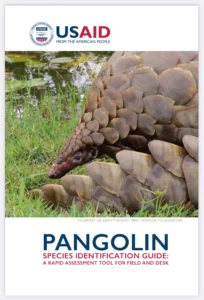
PANGOLIN SPECIES IDENTIFICATION GUIDE: A RAPID ASSESSMENT TOOL FOR FIELD AND DESK
Despite a ban on international trade by the Convention on International Trade in Endangered Species of Wild Fauna and Flora (CITES), pangolins are still one of the most trafficked mammals in the world. As a result, each of the eight species is now threatened with extinction.
The USAID Pangolin Species Identification materials were developed to reverse this trend by assisting law enforcement officers identify pangolins in trade, including body parts and scales.
Go to the USAID Pangolin Species Identification Materials
Not a member yet? Register now
Are you a member? Login now